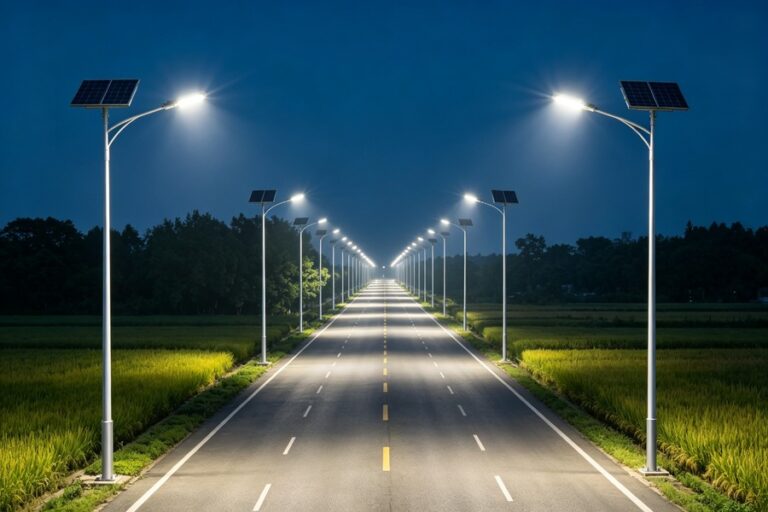
Solar street light with anti overheating function
Date: October 8, 2026
Solar street lights operating in harsh outdoor environments are constantly exposed to intense direct sunlight, high summer ambient temperatures and prolonged heat accumulation inside enclosed cavities. Without proper thermal protection, internal components such as batteries, controllers and LED drivers can easily exceed their safe operating temperature range, triggering accelerated aging, permanent capacity loss and unexpected mid-night shutdowns. A purpose-built anti-overheating function is not a single simple temperature switch. It is a multi-layered thermal protection system that actively monitors, regulates and dissipates excess heat, keeping every critical component inside its designed safe temperature window even under extreme summer conditions.
Real-time multi-point temperature monitoring and dynamic response
The anti-overheating system collects temperature data from multiple critical locations inside the solar street light, instead of relying on a single sensor placed in one generic spot. Dedicated temperature monitoring points are installed on the surface of the energy storage unit, the power controller, the LED heat sink and the inner wall of the main sealed housing. This full coverage ensures that no local hot spot can go undetected, even if heat builds up unevenly inside the assembly during peak midday sunlight.
When any monitored temperature value approaches the preset upper safety threshold, the system does not immediately cut off all functions. Instead, it activates a series of graded, non-disruptive response measures first. It can temporarily adjust the charging current to reduce extra heat generation inside the battery, or slightly modify the LED output level to lower unnecessary heat dissipation from the driver, all while maintaining basic lighting functionality. This gradual, dynamic response avoids sudden, unplanned system shutdowns that would break street lighting service for end users.
Passive thermal isolation and optimized airflow architecture
The most effective anti-overheating measures start with physical design choices that prevent dangerous heat buildup from happening in the first place. Critical heat-generating components are not packed tightly together inside a small, completely enclosed dark cavity that traps heat under direct sunlight. The system uses targeted thermal isolation structures that separate high-temperature components from temperature-sensitive parts, preventing excess heat from spreading and raising the operating temperature of units that cannot tolerate high heat levels.
Many well-designed units incorporate natural convection airflow paths that use the physical properties of hot air to pull heat out of the assembly passively. Hot air naturally rises and exits through upper vent openings, while cooler ambient air is drawn in through lower inlet points, creating a continuous, slow air exchange that carries accumulated heat away without needing power-consuming active fans. All vent openings are protected with dust-proof and water-resistant structures, to prevent fine dust, rain or insect debris from entering and clogging the airflow channels over years of outdoor operation.
Active thermal regulation for temperature-sensitive components
For components that are extremely sensitive to high temperatures, the anti-overheating function adds dedicated active thermal regulation that works independently of general system cooling. The energy storage unit, which is often the most vulnerable part to permanent high temperature damage, is fitted with its own targeted thermal management structure. When its surface temperature exceeds the normal safe working range, the system automatically activates passive heat dissipation structures to pull excess heat away from the cell surfaces, preventing thermal runaway and irreversible capacity loss.
In extremely high ambient temperature conditions that passive cooling alone cannot handle, the system can temporarily redirect a small portion of excess solar power to drive low-power cooling mechanisms that bring component temperatures back down to safe levels. This active regulation ensures that even after multiple consecutive days of 40-plus degree Celsius heat and uninterrupted direct midday sun, the core energy storage and control components never stay at damagingly high temperatures long enough to suffer permanent performance degradation.
Long term thermal aging compensation and fault warning
The anti-overheating system also logs historical temperature data continuously over the full multi-year service life of the street light. It tracks how often peak temperature thresholds are reached, how quickly heat builds up on hot days and how effectively the cooling system brings temperatures back down to normal levels. Over time, the system can identify subtle signs of gradual performance loss in the thermal dissipation path, such as slow accumulation of dust on heat sink surfaces or partial blockage of airflow vents.
When these early warning signs are detected, the system can send out a remote maintenance alert before any actual overheating fault occurs. This allows maintenance teams to schedule routine cleaning and inspection work at a convenient time, instead of responding to unexpected mid-summer failures that leave streets dark. This long term monitoring and compensation capability ensures that the anti-overheating function maintains its full protective performance for many years, instead of slowly degrading and becoming ineffective after the first few summers of field operation.
Recommended articles

Solar street light with solar panel rotation bracket
October 12, 2026
Solar street light with battery temperature monitoring
October 12, 2026