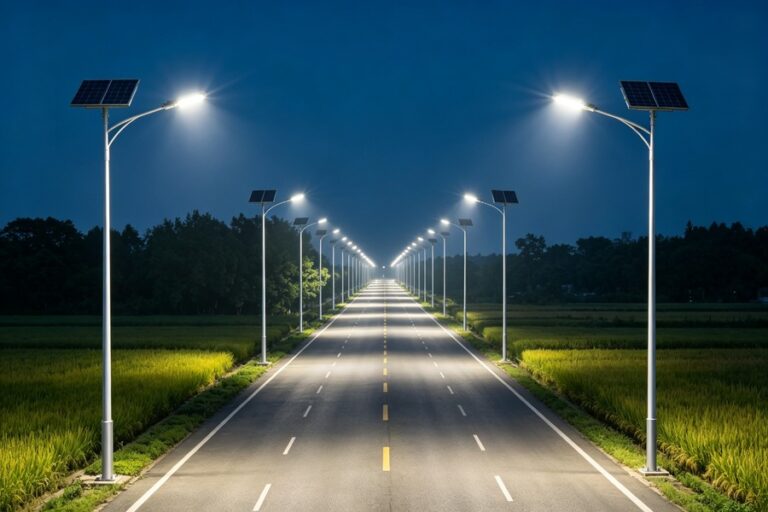
Solar street light with stable voltage output
Date: October 8, 2026
Unstable voltage output from solar street light systems can create a long list of hidden operational issues, including flickering LED light output, accelerated degradation of driver circuits, shortened lifespan of energy storage units and unexpected shutdowns during peak load demand. Voltage fluctuations often appear when solar irradiance changes rapidly, when the battery state of charge shifts across different levels, or when the system switches between different operating modes. A solar street light with a stable voltage output function eliminates these unwanted variations, delivering consistent, regulated power to every connected component regardless of changing external and internal conditions.
Wide input range adaptive voltage regulation
The stable voltage output system is designed to handle a very wide range of input voltage values that naturally appear throughout normal solar street light operation. During strong midday sunlight, the solar panel output can rise to a relatively high peak level, while on heavily overcast days, the same panel output can drop down to a very low minimum value. The system automatically adjusts its internal regulation loop in real time, to absorb all these wide variations on the input side and deliver a completely steady, unchanged voltage level to the load side.
This wide adaptive regulation performance also works when the energy storage unit voltage shifts significantly across its full discharge and recharge cycle. As the battery discharges from fully full to near empty, its terminal voltage naturally falls across a wide voltage span. The stable output function compensates for this gradual voltage drift perfectly, so the LED light source and other connected components never see any change in supply voltage even when the battery itself is nearly drained.
Load transient response and anti-fluctuation control
Sudden changes in load conditions, such as the moment the system switches from low-power standby mode to full brightness lighting mode, can create sharp temporary voltage dips or spikes in unregulated systems. These transient events cause visible light flicker, add electrical stress to semiconductor components and can even trigger unexpected system resets that disrupt normal lighting operation. The stable voltage output system uses a high-speed regulation loop that responds to these load changes in milliseconds, clamping output voltage tightly to its set target value before any noticeable fluctuation can appear.
This level of fast transient control also prevents voltage surges from traveling back into sensitive internal components when sudden load drops occur. Even when unexpected electrical disturbances appear on the output line, the regulation system acts as a protective barrier, stopping these abnormal voltage events from reaching and damaging the LED driver or other expensive connected parts. This consistent voltage stability creates far smoother, more reliable light output that shows no visible flicker or brightness shift at any point during the full night operating cycle.
Long term voltage accuracy and temperature drift compensation
Many basic voltage regulation circuits suffer from slow accuracy drift as internal components age over years of outdoor operation, or when ambient temperature swings across a wide range from freezing winter nights to extremely hot summer afternoons. The stable voltage output system for solar street lights includes built-in reference calibration that automatically compensates for these slow shifts. It continuously compares its actual output voltage against a stable internal reference, and makes tiny, real-time adjustments to keep output voltage locked to its original design value across all temperature conditions and years of extended operation.
This high long term voltage accuracy also protects the service life of the LED light source. When LEDs are supplied with a consistent, perfectly regulated voltage that never drifts above their rated level, they operate at their designed optimal current level, run at a stable temperature and experience far slower lumen depreciation over thousands of operating hours. This eliminates the common problem where street light brightness slowly drops much faster than expected, simply because unregulated voltage levels gradually drifted down over time.
Isolated output protection and fault isolation capability
The stable voltage output section also creates a degree of electrical isolation between different subsystems inside the solar street light. Any abnormal voltage event originating from the solar panel side, such as a temporary voltage spike caused by nearby lightning activity, cannot travel directly across the regulation circuit and reach the lighting load. This adds an extra layer of electrical protection that reduces the risk of secondary component damage when an unexpected electrical disturbance hits the system.
If an unexpected short circuit fault appears on the output line, the stable voltage output system immediately clamps output current to a safe, limited level and holds output voltage at a low, non-destructive value. This prevents the fault from drawing excessive energy directly from the battery, stops overheating wires and components, and prevents minor local faults from cascading into widespread system damage. Once the short circuit condition is removed, the system automatically restores normal stable voltage output, without needing manual reset or replacement of any internal parts.
Recommended articles

Solar street light with solar panel rotation bracket
October 12, 2026
Solar street light with battery temperature monitoring
October 12, 2026