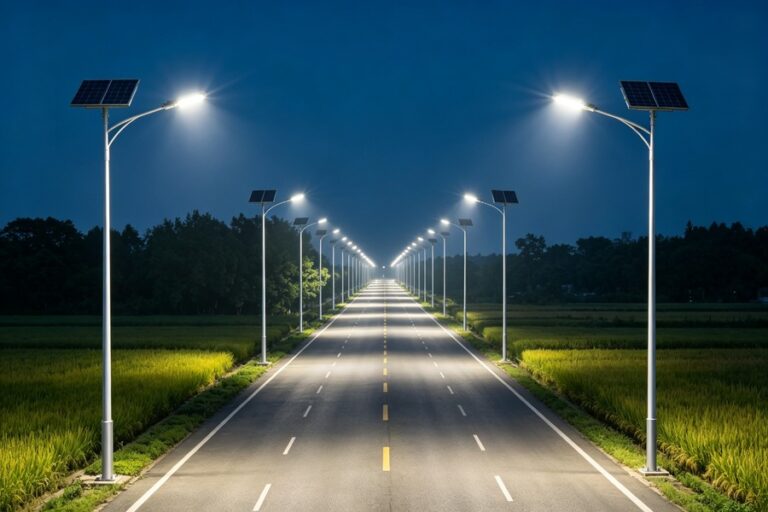
Solar street light with fast charging function
Date: October 9, 2026
Fast charging capability in outdoor solar street lighting systems addresses one of the most persistent historical limitations of traditional designs: slow energy harvesting that leaves units underpowered after consecutive cloudy or overcast days. When engineered correctly, this functionality captures far more usable energy from limited daylight hours, ensuring consistent all-night illumination even in locations with unpredictable, variable weather patterns. The design and operation of these systems are built around practical field experience from thousands of deployments across diverse climate zones.
High-Efficiency Photovoltaic Energy Harvesting Architecture
The core of any fast charging solar street light system is a photovoltaic module optimized for maximum energy capture even under low, diffuse daylight conditions. Unlike traditional panels that perform best only under strong direct midday sun, these setups maintain high energy conversion efficiency across a wide range of light intensity levels, from soft early morning light to the weak, scattered sunlight that appears on heavily overcast days. This means usable energy harvesting starts much earlier at dawn and continues far later at dusk, extending the total effective charging window by multiple hours every day.
The physical layout and tilt angle of the photovoltaic panel are carefully calibrated to match the local geographic latitude and typical seasonal sun path. A precisely tuned mounting angle ensures the panel surface stays as perpendicular to incoming sunlight as possible across the entire day, rather than only for a narrow 2-hour window around noon. This simple, site-specific adjustment alone can increase total daily harvested energy by a significant margin, without requiring any upgrades to panel hardware.
Dust, fine sand, and environmental grime that accumulates on the panel surface over weeks of outdoor operation creates a thin opaque layer that blocks incoming sunlight and drastically cuts charging performance. Fast charging systems are paired with a simple, accessible panel mounting design that makes periodic cleaning quick and easy to perform, ensuring the panel surface stays clear and maintains its maximum energy capture capacity through months of exposure to harsh outdoor conditions.
Dynamic MPPT Charging Control Logic
Advanced maximum power point tracking control forms the intelligent core that enables true fast charging performance. This system continuously samples the real-time output voltage and current from the photovoltaic panel hundreds of times per second, instantly adjusting the operating point to match the exact maximum power available from the panel under current light and temperature conditions. Unlike older basic charge controllers that lock into a single fixed power point for long periods, this dynamic adjustment ensures no available solar energy goes to waste at any moment during the daylight charging cycle.
The control logic also includes built-in temperature compensation that automatically adjusts charging voltage levels based on the internal temperature of the energy storage unit. When operating in extremely hot outdoor environments, the controller lowers the peak charging voltage slightly to protect the battery cells from stress and degradation. In very cold conditions, it safely raises the charging voltage to maintain fast charging speed even when low temperatures would otherwise slow down the energy storage acceptance rate.
Adaptive charging stage sequencing further optimizes the full charging process. The system automatically switches from high-current bulk charging during periods of strong sunlight, to gentle absorption charging as the battery approaches full capacity, then to a low-current float charge to maintain full state of charge without overcharging. This staged approach delivers the fastest possible safe charging speed, while also extending the total operational lifespan of the energy storage system.
Low-Light and Overcast Day Performance Optimization
A well-designed fast charging solar street light system does not rely on bright, direct sunlight to reach a usable state of charge. Even on days with heavy cloud cover that reduces ambient light levels to a small fraction of full sunny intensity, the optimized photovoltaic and control system combination still harvests enough energy to fully charge the battery for a full night of normal illumination. This eliminates the common historical problem where street lights would turn off halfway through the night after two consecutive cloudy days.
The system also prioritizes charging efficiency over non-critical functions during periods of limited available sunlight. It temporarily disables non-essential background monitoring features and reduces idle power draw in the control circuit, diverting every possible milliwatt of harvested solar energy directly into charging the energy storage unit. This intelligent power prioritization ensures the maximum possible amount of captured energy goes toward building up the battery reserve, rather than being wasted on unnecessary internal power consumption.
Even in locations with short winter daylight hours, the fast charging architecture can capture enough energy during the limited available sunlight window to support full night operation. This makes the design highly suitable for high-latitude regions where traditional solar street lights often struggle to maintain reliable performance through the shortest days of the year.
Long-Term Durability and Field Maintenance Compatibility
Every component in a fast charging solar street light system is engineered to withstand decades of exposure to harsh outdoor conditions, from extreme high summer temperatures to freezing winter nights, heavy rain, dust storms, and strong wind loads. The sealed, robust enclosure protects all internal electronics from moisture and particulate ingress, eliminating the risk of internal corrosion that would degrade charging performance over time.
The modular design of the system makes routine field maintenance fast and straightforward for local technical teams. Individual components like the photovoltaic panel, charge controller, and energy storage unit can be accessed and replaced without needing to remove the entire fixture from its mounting pole. This drastically cuts down on maintenance time and eliminates the need for specialized heavy equipment for most routine service tasks.
Built-in overcharge, over-discharge, surge, and over-temperature protection layers work together to shield every part of the system from unexpected electrical stress caused by lightning strikes, grid transient events, or extreme weather conditions. These safety features ensure the system continues operating reliably even when exposed to harsh, unplanned electrical events that would permanently damage less robust traditional solar lighting systems.
Recommended articles

Solar street light with solar panel rotation bracket
October 12, 2026
Solar street light with battery temperature monitoring
October 12, 2026