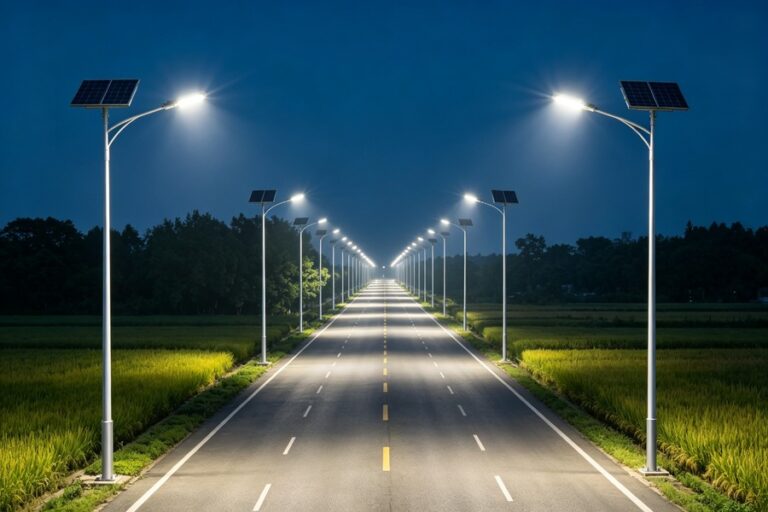
Solar street light suitable for weak sunlight
Date: October 12, 2026
Solar street lighting systems designed for regions with extended periods of weak sunlight face unique operational challenges that standard configurations cannot address. Long overcast seasons, high-latitude locations with short winter daylight hours, and areas frequently covered by heavy haze or seasonal fog all drastically reduce the total solar energy available for collection each day. Systems built specifically for these low-irradiation environments prioritize optimized energy harvesting, ultra-low idle power consumption, and intelligent energy management to maintain consistent all-night lighting performance even after multiple consecutive days of limited sunshine.
Low-Light Photovoltaic Energy Harvesting Optimization
The core of a weak-sunlight optimized system lies in its ability to capture usable energy even when solar irradiance levels are far below standard peak conditions. High-efficiency photovoltaic structures that perform well under diffuse, scattered light can convert far more energy from overcast skies than conventional panels that are only tuned for direct bright sunlight. This design ensures meaningful energy collection starts much earlier in the morning, continues later into the evening, and delivers consistent charging output even during hours of heavy cloud cover.
Advanced maximum power point tracking logic calibrated specifically for low-irradiation conditions continuously adjusts operating parameters to lock onto the real peak power point, even when total available power is only a tiny fraction of the rated panel capacity. Generic tracking algorithms often fail to maintain stable lock under these weak light conditions, wasting large portions of the limited energy that could otherwise be collected. The optimized tracking system eliminates this waste, extracting every possible watt of available power from the panel surface.
Even very small amounts of soiling, dust, or light surface shading can disproportionately reduce energy collection in weak sunlight scenarios. The physical panel layout and surface treatment are designed to minimize dust accumulation, and the tilt angle is carefully calibrated to match local low sun angle conditions during the weakest sunlight season of the year. This small adjustment can deliver a double-digit percentage improvement in total daily energy harvest during the darkest months, making a massive difference to overall system reliability.
Low Self-Discharge Energy Storage System Tuning
The energy storage unit for weak sunlight solar street lighting must be optimized to retain as much of the collected limited energy as possible, rather than wasting it through high internal self-discharge. Storage chemistries with extremely low idle power loss ensure that energy collected on a rare sunny day is not slowly drained away while waiting to be used across multiple consecutive overcast days. This characteristic is far more important for weak sunlight locations than it is for regions with consistent strong sunshine, where the battery is fully recharged almost every single day.
The full operating voltage window of the storage system is carefully aligned with the output characteristics of the low-light photovoltaic array, so usable energy can be extracted from the battery even when its state of charge drops to very low levels. This deep usable range effectively expands the total available energy reserve that can be drawn upon during extended periods without sun, without causing permanent damage or accelerated aging to the storage cells.
Precise over-discharge protection logic is programmed to avoid completely draining the storage unit, while still making full use of every stored watt-hour for lighting. Unlike generic protection systems that cut off output prematurely at a high remaining charge level, the calibrated protection scheme dynamically adjusts its cut-off threshold based on measured historical solar charging trends, ensuring no stored energy is wasted unnecessarily.
Adaptive Lighting and Energy Management Logic
Intelligent dimming control adjusts light output dynamically in response to real-time remaining stored energy and predicted upcoming solar irradiation levels. On nights following a very low sunlight day, the system automatically reduces non-critical full brightness operating time and extends lower-power illumination to ensure basic lighting coverage is maintained all night, rather than draining all stored power in the first few hours after sunset and leaving the street completely dark before dawn.
Motion and ambient light sensing capabilities further optimize energy use by delivering full brightness only when pedestrians or vehicles are present, and dropping to a minimal safe background illumination level when the street is empty. This behavior cuts unnecessary energy consumption drastically during late night hours when traffic is extremely light, stretching the limited stored energy reserve far further than fixed full-power all-night operation could ever achieve.
Historical local weather and sunlight pattern data is integrated into the long-term energy management logic, so the system can proactively build up a small energy reserve on days when sunlight is stronger, in preparation for a forecast multi-day stretch of heavy cloud and weak sun. This forward-looking management strategy prevents unexpected deep discharge events that would otherwise occur when the system is caught off guard by several consecutive days of almost no usable solar energy input.
Recommended articles

Solar street light with solar panel rotation bracket
October 12, 2026
Solar street light with battery temperature monitoring
October 12, 2026