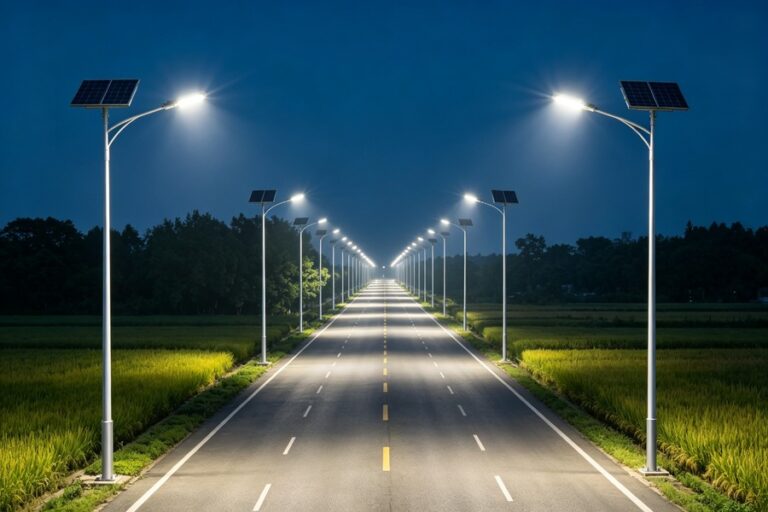
Solar street light supporting cloudy weather
Date: September 24, 2026
A solar street light built to reliably support cloudy weather operation is engineered to deliver consistent, uninterrupted illumination even when direct bright sunlight is unavailable for days at a time. Unlike basic units that struggle to maintain basic lighting output under overcast skies, these systems are designed from the ground up to work with the weak, diffuse sunlight that reaches the ground during cloudy conditions. This capability is especially critical in regions with frequent seasonal rain, persistent cloud cover, or high latitude locations where strong direct sunlight is not available for extended stretches.
Diffuse Sunlight Energy Harvesting
The core of cloudy weather performance lies in the system’s ability to capture usable energy from low intensity, scattered sunlight that standard setups would largely ignore. The power conversion circuit is tuned to operate at extremely high efficiency even when voltage and current output from the solar panel drops to a small fraction of its peak sunny day rating. This means the panel continues trickling small amounts of charge into the battery through even the thickest cloud layers, rather than stopping power generation entirely. Over the course of a full overcast day, these small incremental gains add up to a meaningful amount of stored energy that helps offset the power used for night time lighting.
Weather-Adaptive Illumination Control Logic
Instead of running a fixed brightness schedule that was calibrated for sunny summer days, a cloudy weather optimized system automatically adjusts its lighting profile based on real time available stored energy and recent solar harvesting performance. On days when very little solar energy comes in, the system will prioritize core safety lighting during peak dusk and dawn hours, then smoothly reduce output during late night low-traffic periods to stretch available power as far as possible. All brightness transitions happen gradually and naturally, so the change is barely noticeable to passing pedestrians and drivers, while still ensuring no critical safety zones are ever left unlit. This intelligent adjustment prevents the system from draining its stored reserve too quickly and shutting down unexpectedly before the next sunny period arrives.
Energy Reserve Buffer Calibration
Systems built for reliable cloudy weather operation include a carefully sized energy storage buffer that is explicitly designed to cover multiple consecutive days of minimal solar input. The total usable stored capacity is calibrated to comfortably power a full night of lighting even after two, three, or more straight days of heavy overcast conditions, with no risk of the battery being fully drained. Designers also account for edge cases like partial panel coverage from fallen leaves, thin layers of snow, or light dirt buildup that can further reduce already low cloudy weather power generation. This extra buffer eliminates the most common failure mode of basic solar street lights, which go dark after just one or two days without bright sun.
Low Parasitic Loss System Architecture
Every component in a cloudy weather optimized solar street light is selected to minimize unnecessary parasitic energy loss that would otherwise waste the limited amount of power harvested on overcast days. Wiring and connection paths are sized to keep resistive heat loss extremely low, and the control unit itself draws almost no standby power during daylight hours when the system is idle. The light source is also engineered to deliver maximum visible lumens per watt, converting every single unit of stored electricity into as much useful illumination as possible. These small cumulative efficiency gains add up to a very large extension of available runtime, making every watt of weak cloudy day solar input count toward actual usable street lighting.
Overcast Condition Long Term Durability
Consistent operation through repeated cycles of cloudy weather also requires the system to handle frequent partial charge states that would degrade standard components much faster. The energy storage management logic is programmed to avoid unnecessary full discharge cycles during long stretches of low sunlight, and instead operate stably in a partial state of charge for extended periods without accelerating internal wear. This ensures the system can reliably deliver cloudy weather performance year after year, without its usable reserve shrinking over time as internal components degrade prematurely.
Recommended articles

Solar street light with solar panel rotation bracket
October 12, 2026
Solar street light with battery temperature monitoring
October 12, 2026