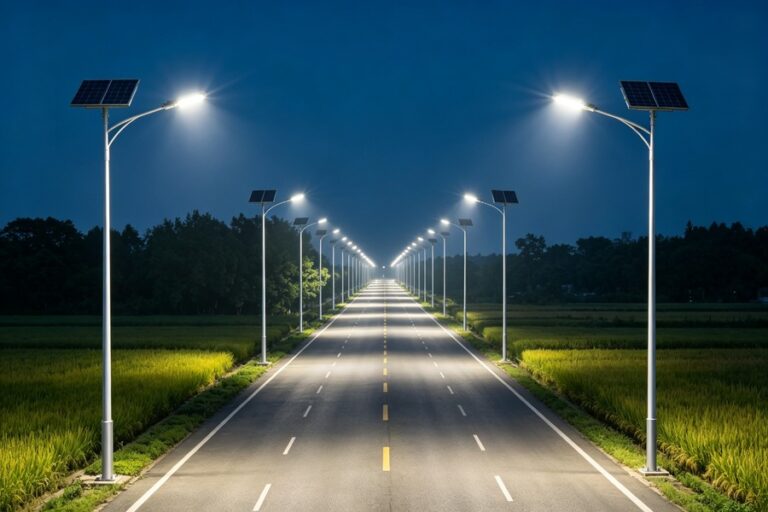
Solar street light with over discharge protection
Date: September 29, 2026
A solar street light with over discharge protection is engineered to prevent permanent battery damage that can happen when the energy storage cell is drained far below its safe operational threshold, a common cause of premature failure in many basic off-grid outdoor lighting systems. Without this protective feature, a solar street light can continue running long after the battery has dropped past its recommended low-voltage limit, forcing the cell into deep discharge conditions that erode its usable capacity, shorten its cycle life, and in severe cases create irreversible internal damage. Over discharge protection is not a simple on-off switch; it is a carefully calibrated, context-aware control function that balances the need to deliver reliable lighting with the critical requirement of preserving the long-term health of the energy storage system. This makes it one of the most important foundational features for any solar street light that is expected to deliver consistent, low-maintenance performance across years of outdoor deployment.
Voltage threshold and load cut-off logic
The core of over discharge protection lies in precise, real-time monitoring of battery voltage, paired with pre-set cut-off thresholds that are carefully matched to the specific chemistry of the energy storage cell. The system does not wait until the battery is almost completely empty before taking action; instead, it tracks voltage trends under real operating load, accounting for the temporary voltage drop that naturally occurs when the light is drawing full power. When the measured voltage falls to the calibrated safe lower limit, the control system triggers a controlled, smooth cut-off of the lighting load rather than letting the battery drain down to dangerously low levels. This prevents the cell from being pushed into a state where internal chemical reactions cause permanent degradation, such as plate sulfation in older battery chemistries or irreversible lithium site loss in modern high-density cells. The threshold values are tuned to avoid overly aggressive cut-offs that would unnecessarily shorten lighting runtime, while still providing a hard safety boundary that the battery is never allowed to cross.
Gradual dimming as an intermediate protective step
Many well-designed over discharge protection systems do not jump directly from full brightness to complete shutoff, which can leave road users or pedestrian areas suddenly in unexpected darkness. Instead, the control logic uses a staged response that starts with gradual, controlled dimming of the light output as battery voltage approaches the lower safety threshold. This extended intermediate phase still delivers usable, reduced lighting for a significant extra period, while drawing far less power from the battery and slowing the rate of discharge dramatically. This approach balances two competing priorities: it preserves battery health by avoiding deep over discharge, and it ensures that public safety lighting does not cut out abruptly in the middle of the night when it is still needed most. This staged protection behavior is far more practical for real-world outdoor deployment than a simple, uncalibrated hard cut-off that prioritizes battery protection at the cost of lighting availability.
Automatic recovery and post-charge reactivation rules
Over discharge protection systems are also designed with intelligent recovery logic that prevents the light from flicking back on immediately the moment battery voltage rises just slightly above the cut-off threshold. This kind of unregulated rapid cycling would create repeated small partial discharge cycles that cause unnecessary wear on both the battery and the lighting driver. Instead, the system waits until the solar panel has delivered a meaningful, measurable amount of charge back into the battery, bringing the cell voltage up to a clearly defined recovery threshold that sits well above the original cut-off point. Once this higher voltage level is reached, the protection lock releases smoothly, and the system resumes normal dusk-to-dawn lighting operation. This prevents the system from oscillating between on and off states during weak, low-light conditions like heavy overcast days at dawn or dusk, and ensures the battery only returns to active duty once it has enough stored energy to support a full, stable lighting cycle without risk of slipping back into an over discharge state.
Recommended articles

Solar street light with solar panel rotation bracket
October 12, 2026
Solar street light with battery temperature monitoring
October 12, 2026