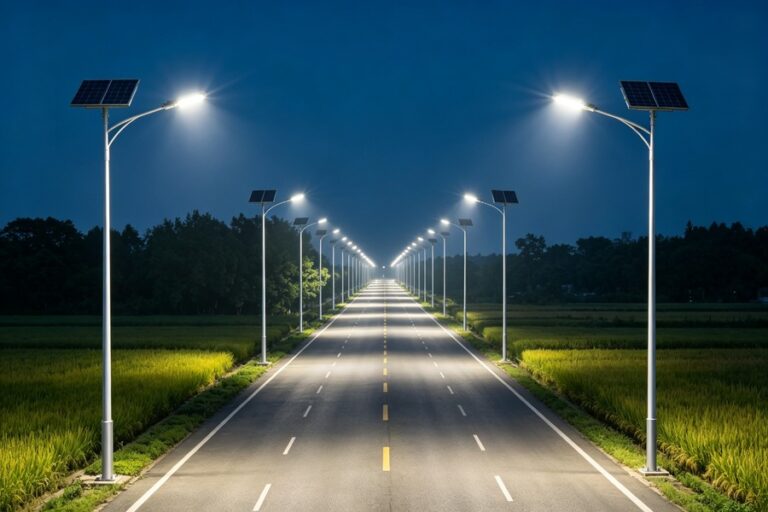
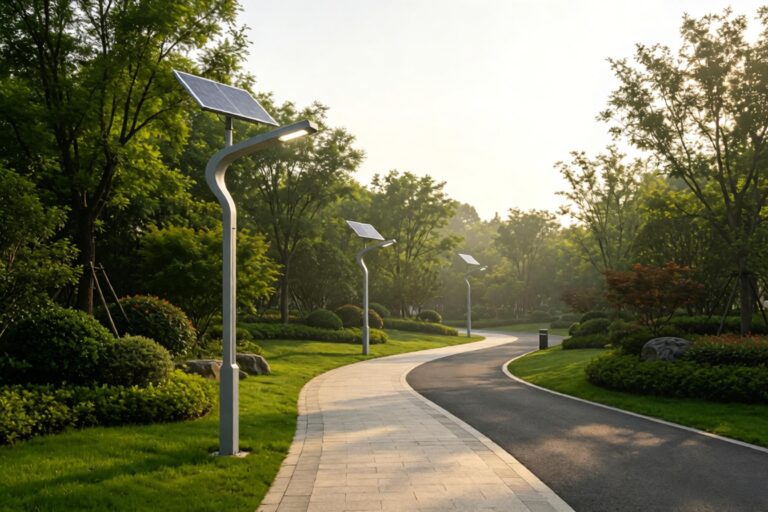
Solar street light with solar panel rotation bracket
Date: October 12, 2026
Solar street lights operating in locations with highly variable seasonal sun angles, frequent overcast conditions, or high-latitude winter daylight cycles often struggle to collect sufficient solar energy to support reliable all-night operation. A solar panel rotation bracket allows the photovoltaic surface to be adjusted to an optimal orientation, rather than being locked permanently in a fixed position at the time of installation. This simple mechanical adjustment capability delivers measurable improvements in total daily energy harvest, especially during the weakest sunlight months of the year when every collected watt-hour directly impacts system uptime and lighting reliability.
Angular Alignment Optimization for Seasonal Sun Path Variation
The rotation bracket allows installers to set the panel tilt angle to perfectly match the local latitude and the specific seasonal sun path that matters most for reliable operation. For locations that face long, dark winters with very low sun angles, tilting the panel to a steeper seasonal position ensures the sun’s rays strike the photovoltaic surface at near-perpendicular incidence, maximizing energy collection during the months when solar resource is scarcest. This adjustment alone can deliver a very noticeable increase in winter charging performance that no fixed-angle installation can match.
At different times of the year, maintenance teams can make small targeted adjustments to the bracket to compensate for the natural north-south shift of the sun’s peak elevation. This seasonal fine-tuning avoids the common problem where a panel set to a tilt angle optimized for summer sunlight performs very poorly during the winter months, leaving the solar street light at high risk of running out of stored power before dawn. The ability to reorient the panel without removing it from its mounting structure makes this regular tuning fast and low-effort.
For sites that are partially shaded by nearby trees, buildings, or terrain features during specific parts of the day, the rotation bracket can also be used to shift the panel’s horizontal azimuth angle slightly away from the standard due-south orientation. This small adjustment avoids the worst hours of direct partial shading, which can cause disproportionate drops in total panel output even when only a small section of the photovoltaic surface is covered.
Mechanical Durability and Long-Term Field Performance
The rotation bracket is engineered to maintain its set angular position securely across years of exposure to strong wind, heavy snow load, extreme temperature cycling, and UV radiation. Loose or poorly designed brackets that shift position slowly over time will gradually drift away from their optimal alignment, eroding the energy harvest gains that were achieved during initial installation. A robust, properly engineered bracket eliminates this drift, preserving the exact calibrated panel orientation for multiple years without requiring frequent re-tightening or readjustment.
All load-bearing points on the bracket are designed to distribute mechanical stress evenly, avoiding weak points that could crack or deform under unexpected extreme weather conditions. This structural reliability is especially critical for street lights installed in exposed, open locations with no natural wind protection, where sudden strong gusts can place very high dynamic force on the panel and its supporting structure. A failure at this point could cause the panel to shift completely out of alignment or even detach from the pole entirely.
The rotational adjustment mechanism itself is designed to remain smooth and operable even after years of exposure to outdoor conditions, without seizing up due to rust, dust accumulation, or corrosion. This ensures that when maintenance teams arrive on site to perform seasonal angle adjustments, they can reposition the bracket easily without needing specialized tools or applying excessive force that could damage the panel mounting points.
Energy Harvest Performance Validation and Post-Installation Tuning
After the bracket is initially set to its target angle, field technicians can verify real-time output of the photovoltaic panel under actual sunlight conditions to confirm alignment is optimized. By making small incremental adjustments to the rotation position and monitoring changes in real-time charging current, they can lock in the exact orientation that delivers maximum measured power output for that specific site and season. This hands-on, on-site tuning ensures the system achieves far better performance than any generic pre-set angle selected before installation.
For locations with frequent morning fog or afternoon haze, the bracket can be adjusted to prioritize energy collection during the specific time window of day when local atmospheric conditions are clearest. This targeted alignment makes far more efficient use of the limited available sunlight, rather than wasting part of the panel’s collection potential pointing toward sections of the sky that are almost always obscured by local weather patterns.
Over the full annual operating cycle, teams can track historical charging data across different bracket angle settings to identify the optimal alignment profile that delivers the most consistent year-round energy harvest. This data-driven tuning process ensures the solar street light maintains reliable performance across every season, without the seasonal dips in charging output that are so common in fixed-angle solar street light installations.
Recommended articles

Solar street light with battery temperature monitoring
October 12, 2026
Solar street light suitable for weak sunlight
October 12, 2026