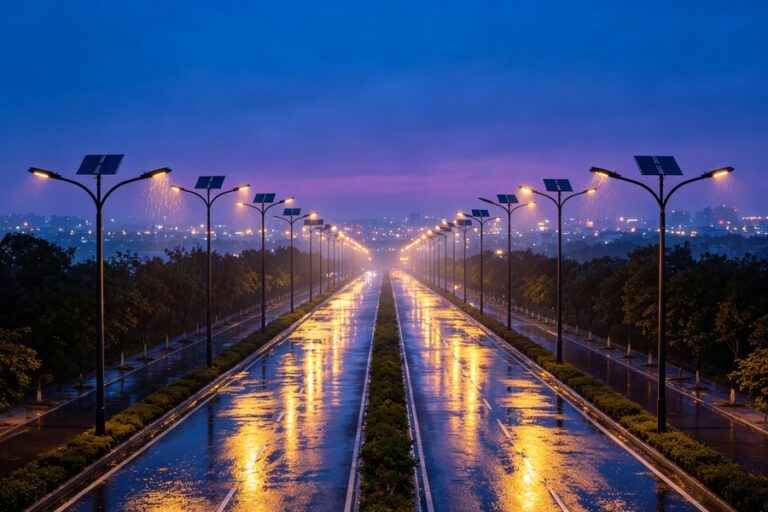
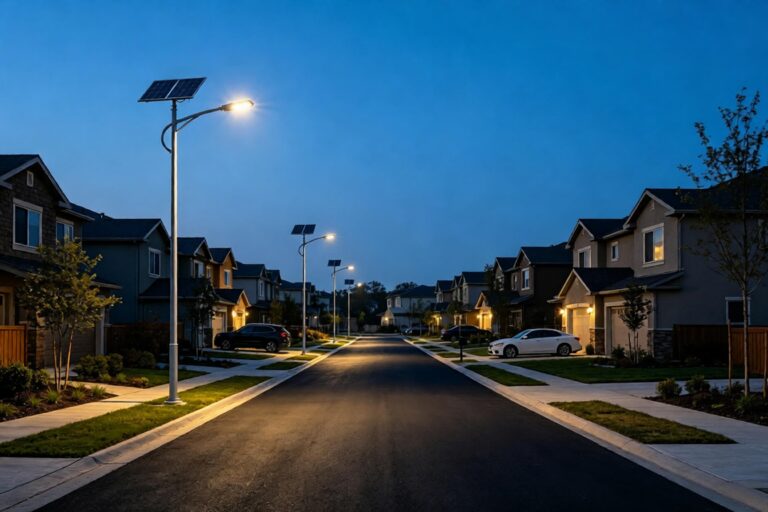
Solar street light with anti glare lens
Date: October 14, 2026
Solar Street Light with Anti Glare Lens
Many outdoor lighting installations overlook glare control, even though poorly designed solar street lights can create uncomfortable bright spots that distract drivers, irritate pedestrians, and reduce overall nighttime visibility. An anti-glare lens system reshapes the raw light output from the LED source, directing it precisely onto the road or walking surface rather than scattering it upward or into people’s eyes. This small but critical adjustment improves public safety, reduces light pollution, and helps the solar system operate more efficiently by making every watt of generated light count.
Real-world glare issues in outdoor lighting
After working on dozens of rural and suburban solar lighting projects, I have seen first-hand how unfiltered LED light can cause real problems. On quiet residential roads, a standard solar street light without glare control can create bright, blinding halos that make it hard for drivers to see pedestrians crossing the street. On shared pedestrian and cycle paths, the harsh, unshielded light creates sharp shadows that hide small obstacles like curbs or loose stones, increasing the risk of trips and falls. In residential areas near the lights, residents often complain about light spilling through bedroom windows, disrupting sleep patterns and making the entire neighborhood feel less restful after dark. These issues are not caused by insufficient brightness; they stem from poor light distribution that wastes energy and creates unnecessary visual stress.
How anti-glare lens systems reshape light output
A properly engineered anti-glare lens does not simply dim the light source. Instead, it uses a carefully calculated combination of refraction and reflection to redirect the light beam into a wide, flat, rectangular pattern that matches the shape of the road or path below. The lens blocks direct line of sight to the bright LED chip, so no one standing or driving near the light can look directly into the source. Instead of creating a single hot spot directly under the fixture, the light spreads evenly across the entire target surface, creating uniform brightness with no harsh peaks or dark gaps. This means the same amount of total light output covers a larger area more effectively, so the solar panel and battery do not need to be oversized to achieve good illumination.
Practical field installation and adjustment tips
From my on-site experience, the performance of an anti-glare solar street light depends almost as much on proper installation as it does on the lens itself. When mounting the fixture, make sure the lens surface stays perfectly clean and free of fingerprints during installation, as even small smudges can scatter light and create unintended glare. Adjust the tilt angle of the fixture carefully after mounting, so the edges of the light pattern line up exactly with the edges of the road or path. Avoid tilting the fixture too far downward, which can create a sharp bright circle right under the pole while leaving areas farther away in shadow. After the first week of operation, return to the site after dark and walk or drive along the full length of the lit area. Check for any unexpected bright spots that might still cause glare, and make tiny, incremental tilt adjustments until the light distribution feels smooth and comfortable for all users.
Recommended articles

Solar street light with wide lighting range
October 14, 2026
Solar street light with uniform light distribution
October 14, 2026