Solar street light with wide lighting range
Date: October 14, 2026
Solar Street Light with Wide Lighting Range
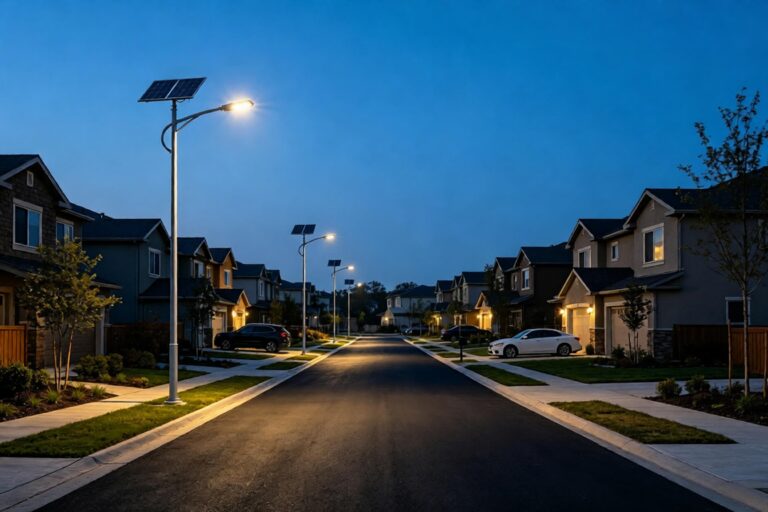
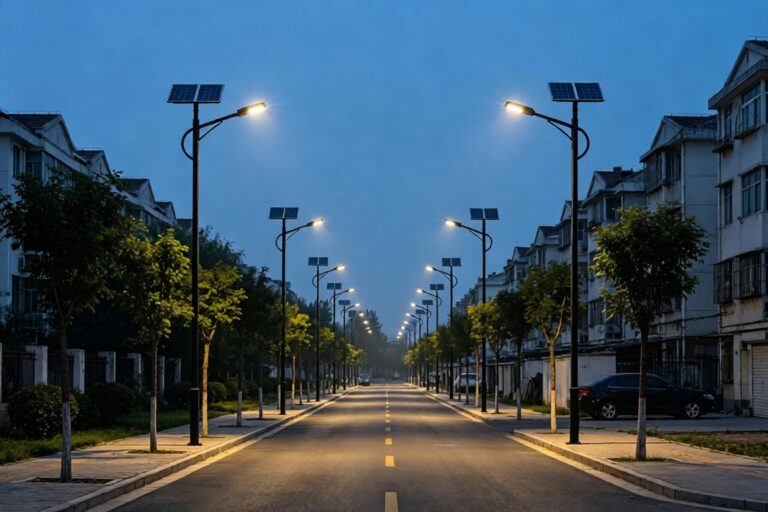
A wide lighting range is one of the most sought-after features for modern solar street light installations, especially on large roads, sprawling parking lots, and open public spaces that cannot be fully covered by narrow, focused light patterns. Many basic solar street lights produce a concentrated, narrow beam that only illuminates a small patch of ground directly below the pole, forcing installers to place poles much closer together than necessary. A properly designed wide-range system spreads light far and evenly across a large area, reducing the total number of fixtures needed and creating better continuous coverage across the entire site.
Practical site challenges for wide-area solar lighting
Over years of working on outdoor lighting projects, I have encountered countless scenarios where a standard narrow-beam solar light simply cannot deliver the coverage the site demands. On multi-lane roads, a narrow light pattern leaves entire lanes in partial shadow, making it hard for drivers to clearly see lane markings, road signs, and other road users. On large open parking lots, scattered dark zones create hidden pockets where people feel less safe walking to their cars after dark. On rural highway shoulders and unpaved side roads, narrow beams fail to extend far enough to illuminate the full width of the path, increasing the risk of accidents for cyclists and pedestrians. The most common mistake I see teams make is trying to solve this by cranking up the total LED power, which drains the battery far too fast and wastes most of the extra energy as glare rather than useful, usable light on the ground.
Optical design for extended coverage
A wide lighting range system relies on precision-engineered secondary optics that spread the light beam horizontally and laterally, rather than concentrating it straight down. The optics are shaped to create a broad, elliptical or rectangular light footprint that stretches far beyond the base of the pole, covering multiple lanes or a wide stretch of path in one single sweep. The design is carefully calibrated to avoid spilling unnecessary light upward into the sky or onto nearby buildings, so almost all the generated light lands exactly where it is needed. This means the same amount of solar-generated power can cover two to three times the area of a standard narrow-beam fixture, without creating the harsh glare that comes from simply over-powering a basic light source.
On-site installation and alignment best practices
From my hands-on field experience, even the best wide-range optical design will underperform if it is not mounted and aligned correctly. First, confirm the mounting height matches the specifications for the wide-beam design, as these systems are engineered to spread light properly only when placed at a specific height. If the fixture is mounted too low, the light pattern will be too compressed and fail to reach its full range. If mounted too high, the light will spread too thin and create dim, uneven coverage. After mounting, adjust the horizontal rotation and tilt angle carefully to align the long axis of the wide light pattern exactly with the direction of the road or the longest dimension of the parking lot. Once the sun sets, walk the full perimeter of the target area to check for any unlit corners or edges. Make small, incremental adjustments to the angle until the full intended area is covered with smooth, consistent light. This simple on-site fine-tuning unlocks the full wide-range performance the system was designed to deliver.
These practical, field-tested methods help wide-range solar street lights deliver maximum coverage across large outdoor spaces, making them far more efficient and cost-effective for large-scale public lighting projects.
Recommended articles

Solar street light with uniform light distribution
October 14, 2026
Solar street light with anti glare lens
October 14, 2026