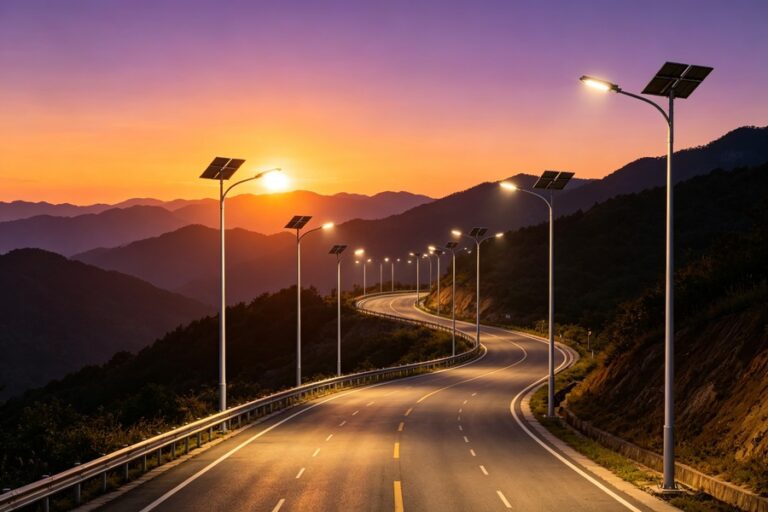
Solar street light constant current LED drive stable lighting operation logic
Date: August 4, 2026
How Constant Current LED Drivers Keep Solar Street Lights Burning Steady Through the Night
There is a quiet engineering battle happening inside every solar street light after sunset. The battery is draining. The voltage is dropping. Ambient temperature is shifting. Yet the light on the street below needs to look exactly the same at hour one as it does at hour eight. That consistency doesn’t happen by accident. It happens because a constant current LED driver is doing something deceptively simple — feeding the LED array a steady, unwavering current regardless of what chaos is unfolding inside the power system.
This is the piece most people overlook when they talk about solar lighting. Everyone focuses on panel wattage and battery capacity. Almost nobody asks how the driver actually maintains stable illumination when the input voltage is a moving target. Understanding this logic matters, especially for municipal planners, lighting engineers, and anyone responsible for long-term infrastructure reliability.
The Core Problem: Why Voltage Instability Kills LED Performance
LEDs are current-driven devices. Not voltage-driven. This distinction is everything. An LED does not care what the supply voltage reads at any given moment. It cares about how many milliamps flow through it. Push too little current and the light dims. Push too much and the junction overheats, color shifts, and lifespan collapses.
In a solar street light, the power source is inherently unstable. A lithium battery bank at full charge might sit around 13.4V. By 3 a.m., after eight hours of discharge, that same battery could be down to 11.2V or lower depending on load and temperature. A naive driver that simply regulates voltage would watch the LEDs fade noticeably as the night progresses — bright at dusk, anemic by midnight. That is not acceptable for road safety applications.
Constant current drivers solve this by decoupling the LED behavior from the battery state. The driver continuously adjusts its internal resistance and switching frequency to maintain a fixed output current — say 700mA or 1050mA — even as the input voltage sags or spikes. The LED sees the same current. The human eye sees the same brightness. The physics inside the driver is doing all the heavy lifting.
What Constant Current Actually Means in Practice
When engineers say “constant current,” they mean the driver actively monitors the output current in real time and corrects any deviation within milliseconds. This is not a passive resistor doing the job. It is an active switching circuit — typically a buck, boost, or buck-boost topology — that reads the current through a sense resistor and adjusts the PWM duty cycle or switching frequency to lock it back to the target.
In a buck configuration, the driver steps down a higher battery voltage to match what the LED string needs while holding current steady. In a boost setup, it does the opposite — raising a lower battery voltage to keep the current flowing. Many modern solar street light drivers use buck-boost topology because the battery voltage range during a full discharge cycle can cross above and below the LED forward voltage threshold. A buck-only driver would stop regulating once the battery drops too low. A boost-only driver wastes efficiency when the battery is high. The hybrid approach covers the full window.
The switching frequency typically runs between 100kHz and 1MHz in quality designs. Higher frequency means smaller inductors and capacitors, which means a more compact driver board — a real advantage when you are cramming everything into an all-in-one housing with limited internal volume. But higher frequency also means more switching loss and more electromagnetic noise, so the design has to balance compactness against thermal performance.
How the Driver Logic Responds to Real-World Night Conditions
Dimming Profiles and Adaptive Brightness Control
Most solar street lights do not run at full blast all night. That would be a waste of stored energy and would shorten battery cycle life unnecessarily. Instead, the driver logic follows a programmed dimming curve — often called a lighting profile or time-based dimming schedule.
A typical profile might look like this: 100% output from dusk until 10 p.m., then 70% from 10 p.m. to midnight, then 40% or 50% from midnight until dawn. Some systems go further and use motion sensors or astronomical timers to adjust dynamically. Regardless of the trigger, the constant current driver still has to do its job — maintaining whatever current level the profile calls for, not just one fixed number.
This is where the driver’s internal control loop shines. When the dimming command shifts from 100% to 70%, the driver does not just chop the current on and off. That would cause visible flicker and stress the LED chips. Instead, it smoothly reduces the PWM duty cycle or adjusts the analog current reference so the transition is seamless. The light dims gradually, the LED junction temperature stays within spec, and the driver never loses regulation.
Field engineers who have tested dimming transitions in tropical climates report that poor driver logic shows up as a visible step-change in brightness — the light suddenly drops rather than easing down. Good driver logic makes the change imperceptible to anyone standing under the pole. That smoothness is a direct result of how the control algorithm is tuned, not just what components are on the board.
Thermal Feedback and Current Derating
Here is a detail that separates robust designs from fragile ones. As the LED junction heats up during operation, its forward voltage drops slightly. If the driver does not account for this, the current would naturally rise — a positive feedback loop that can end in thermal runaway.
Quality constant current drivers include thermal feedback. An NTC thermistor mounted near the LED module or on the driver PCB feeds temperature data back to the control IC. When junction temperature approaches the maximum rated — often 85°C or 105°C depending on the LED package — the driver automatically derates the current. It might drop from 1050mA to 800mA or lower, reducing brightness slightly but preventing catastrophic failure.
This derating is not a flaw. It is a safety feature. In solar street lights installed in desert environments where ambient temperatures can exceed 50°C and the housing has limited heat dissipation, thermal derating can be the difference between a driver that lasts ten years and one that burns out in two summers. The driver logic has to be smart enough to know the difference between a temporary temperature spike and a sustained overheat condition — and respond accordingly without nuisance shutdowns.
Why Driver Quality Defines the Real Lifespan of a Solar Street Light
The solar panel will last 25 years. The LEDs, if properly driven, can easily exceed 50,000 hours. The battery is the component everyone worries about, and rightfully so. But the driver is the silent gatekeeper. A driver with sloppy current regulation, no thermal protection, and a basic buck topology that cannot handle the full battery voltage range will degrade the LEDs faster than almost any other factor.
Look at failure data from municipal installations. The single most common cause of premature LED failure in solar street lights is not bad LEDs — it is bad drivers. Overcurrent events during battery voltage spikes, flicker caused by unstable control loops, and thermal damage from missing derating logic account for the vast majority of field failures that get misdiagnosed as “LED quality issues.”
When specifying or evaluating solar street lighting systems, the driver specifications deserve as much scrutiny as the panel and battery. Check for the topology type. Verify the current regulation accuracy — good units hold within ±3% or better. Confirm the presence of over-temperature protection, short-circuit protection, and open-circuit detection. Ask whether the driver supports the full dimming range you need and whether it handles the complete input voltage window from fully charged to end-of-discharge without dropping out of regulation.
These are not luxury features. They are baseline expectations for any solar street light expected to perform reliably in the field for more than a handful of years. The constant current driver does not get the glory that the solar panel does, but without it doing its job precisely, nothing else in the system matters much.
Recommended articles

Solar street light with high transmittance lens
October 13, 2026
Solar street light with insulated wiring
October 13, 2026