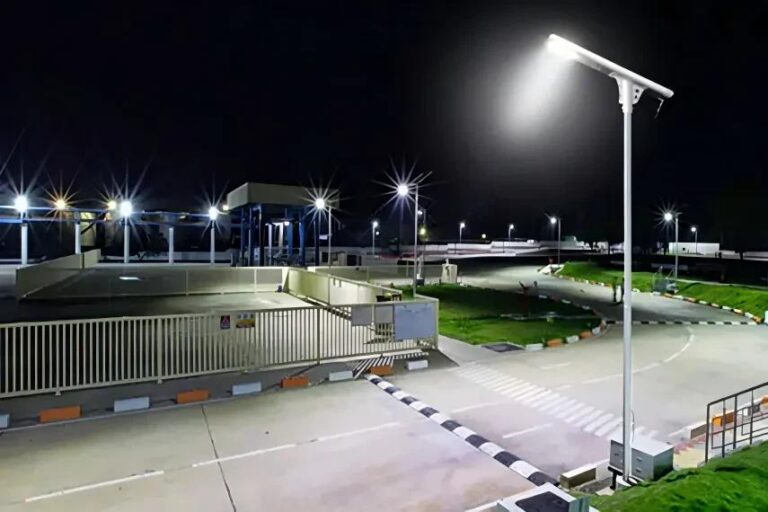
Solar street light single lamp independent intelligent control working mode
Date: August 12, 2026
Solar Street Light Single Lamp Independent Intelligent Control Working Mode
Forget the old image of solar street lights running on dumb timers or basic photocells that do nothing more than turn on at dusk and off at dawn. The single lamp independent intelligent control working mode represents a fundamental shift — each pole becomes its own autonomous decision-making unit, equipped with embedded processing power, local sensing, and wireless communication capability. No master controller runs the show. No central server dictates schedules. Every light thinks for itself, adapts to its immediate surroundings, and reports back only what matters.
This architecture has gained traction in municipal deployments, highway corridors, and remote rural installations precisely because it eliminates single points of failure. If one unit malfunctions, the others keep working. If communication drops, each lamp falls back on its own logic. That resilience, combined with granular energy optimization, makes the single lamp intelligent mode a practical answer to real-world operational headaches that plague centralized systems.
What Makes a Single Lamp Truly Independent
Independence in this context means three things. First, the lamp has its own microcontroller — a small but capable processor running firmware that handles charging management, load control, sensor interpretation, and communication protocols without relying on any external brain. Second, it carries its own real-time clock so it knows what time it is even when the wireless network goes silent for days. Third, it stores its configuration locally in non-volatile memory, so a power cycle or a communication outage does not erase its operating parameters.
The power architecture supports this autonomy. A photovoltaic panel charges a dedicated battery pack sized for that specific pole. The charge controller sits on the same circuit board as the microcontroller, managing the solar input independently. The LED driver receives its commands directly from the local processor, not from a remote command center. This tight integration of power and intelligence at the lamp level is what separates a genuinely independent unit from a centralized system that merely pretends to be distributed.
On-Board Sensing That Drives Local Decisions
Each intelligent lamp typically carries an ambient light sensor, a temperature sensor, and sometimes a passive infrared motion detector. The photocell tells the controller whether it is day or night and how bright the surroundings are. The thermistor feeds battery temperature data back into the charging algorithm so voltage thresholds adjust in real time. The PIR sensor monitors a radius of roughly 8 to 15 meters around the pole for movement — pedestrians, vehicles, animals — and triggers a brightness boost when activity is detected.
These sensors feed raw data into the microcontroller, which runs conditional logic at the firmware level. The logic is not complicated. If ambient light falls below 15 lux AND battery voltage is above 11 volts AND it is between 6:00 PM and 5:00 AM, then power the LED at the scheduled dimming level for the current time segment. If the PIR sensor fires, override the dimming level and jump to full output for a preset duration — say 30 to 60 seconds — then return to the scheduled level. If battery voltage drops below 10.5 volts, cut output to minimum and flag a low-battery alert for the maintenance team.
That entire decision tree lives on the lamp itself. No cloud server. No internet connection. Just silicon and sensors doing their job in a weatherproof enclosure on top of a pole.
How Wireless Communication Fits Without Breaking Independence
Independent does not mean isolated. The single lamp intelligent mode almost always includes a wireless transceiver — typically operating on sub-gigahertz frequencies like 470 MHz, 868 MHz, or 915 MHz, or on protocols such as LoRa, Zigbee, or NB-IoT depending on range and bandwidth needs. This radio lets each lamp send status reports, receive firmware updates, and accept new scheduling parameters from a network coordinator — but only when communication is available.
The critical design principle is graceful degradation. When the network is up, the lamp can receive optimized schedules, push diagnostic data like battery health and LED current draw, and even participate in mesh routing to relay messages from neighboring poles. When the network goes down — due to storm damage, interference, or simply a dead gateway — the lamp does not panic. It reverts to its locally stored schedule and continues operating exactly as it would if it had never heard of a network at all.
This fallback behavior is what gives the architecture its reputation for reliability. Centralized systems collapse when the hub fails. A single lamp intelligent system loses one node’s connectivity while every other node hums along unaffected.
Mesh Networking and Peer-to-Peer Data Relay
In larger deployments, individual lamps often form a mesh network where each unit can pass data to its neighbors. A lamp at the edge of cellular or gateway coverage relays its status through intermediate poles until the message reaches a collection point. This hop-by-hop approach extends effective range dramatically without requiring every single pole to sit within direct radio contact of a base station.
The mesh protocol also enables collective intelligence. If one lamp detects an unusual pattern — say, its motion sensor fires continuously for hours, suggesting a possible fault or a permanent obstruction — it can alert adjacent lamps to adjust their own behavior. A nearby pole might increase its standby brightness as a precaution. This peer-aware behavior emerges from simple rule sets programmed into each node, not from a central algorithm issuing commands.
Energy Management That Adapts Lamp by Lamp
Perhaps the most compelling advantage of single lamp intelligence is per-unit energy optimization. In a centralized system, every pole follows the same schedule regardless of local conditions. A lamp in a shaded alley gets the same charging profile as one in full sun. A pole with a partially degraded battery gets treated identically to one with fresh cells.
The independent mode changes all of that. Each lamp monitors its own solar input, its own battery state of charge, its own discharge curve, and adjusts accordingly. A pole that receives only four hours of direct sunlight because of nearby building shadows will automatically reduce its nightly output to stay within safe discharge limits. A pole with a healthy battery and unobstructed solar exposure will run closer to full brightness.
This per-lamp calibration happens continuously, not just at commissioning. The microcontroller tracks cumulative charge-discharge cycles, estimates remaining battery capacity using coulomb counting or impedance tracking methods, and refines its predictions night after night. Over weeks and months, the system learns the specific energy budget of each installation site and optimizes within those constraints without any human intervention.
Fault Detection and Self-Diagnostic Reporting
Each intelligent lamp runs self-checks on its own hardware. The microcontroller monitors LED forward voltage to detect open or shorted diodes. It watches charge controller output for abnormal current spikes that might indicate a failing MOSFET. It tracks battery voltage trends to spot cells that are losing capacity faster than their neighbors.
When a fault is detected, the lamp does not just shut down silently. It encodes the fault type, severity, and timestamp into a data packet and pushes it through the wireless network when available. Maintenance teams receive actionable alerts — not generic “something is wrong” messages but specific diagnoses like “LED string 2 open circuit” or “battery capacity below 60 percent of rated.” This targeted reporting cuts troubleshooting time and reduces unnecessary site visits, which matters enormously for installations spread across hundreds of kilometers of roadway.
The self-diagnostic capability also feeds into predictive maintenance models. When aggregated data from dozens or hundreds of lamps reveals a pattern — for instance, that batteries in a particular geographic zone degrade 20 percent faster than elsewhere — planners can investigate root causes like soil corrosion, excessive heat exposure, or inadequate panel sizing and address the problem before it becomes widespread.
Recommended articles

Solar street light for botanical garden
September 2, 2026
Solar street light for parking lot
August 14, 2026