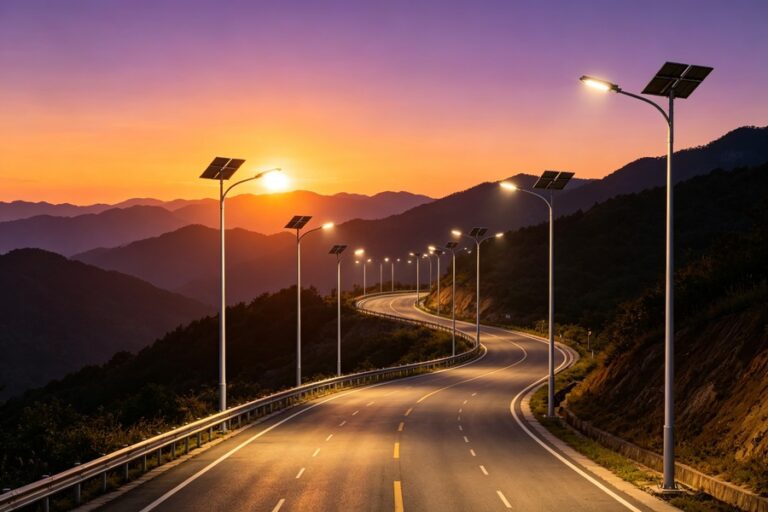
Solar street light for mountain area
Date: August 17, 2026
Solar street lighting in mountain areas must address challenges distinct from urban or coastal installations. The primary considerations shift to extreme temperature fluctuations, reduced solar access due to terrain and weather, difficult access for maintenance, and the need for reliable illumination on winding roads or remote trails. A system designed for these conditions prioritizes robust energy management, durable components, and strategic placement to ensure year-round functionality.
Managing Solar Energy Harvest in Complex Terrain
Mountainous terrain can create significant shading, with peaks and valleys casting long shadows that reduce daily solar exposure. Site assessment is critical. The installation location must be carefully selected to maximize southern exposure (in the Northern Hemisphere) and avoid shading from surrounding topography and dense vegetation. Using solar panels with higher efficiency monocrystalline cells is non-negotiable to capture the maximum possible energy during shorter daylight hours, especially in winter. The tilt angle of the panel should be adjusted more steeply than in flat regions to better face the lower winter sun and to help shed snow accumulation. For areas with persistent morning fog or frequent cloud cover, oversizing the solar panel array relative to the light’s power consumption provides a necessary energy buffer to maintain operation through consecutive low-light days.
Battery Performance Across Extreme Temperature Ranges
Temperature swings from high daytime heat to freezing nighttime lows are common in mountains and are the primary factor affecting battery lifespan and capacity. Lithium iron phosphate (LiFePO4) batteries are strongly recommended for these environments. They maintain a much more stable performance across a wide temperature range, from -20°C to 60°C, and suffer less capacity loss in cold weather compared to traditional lead-acid or standard lithium-ion batteries. The battery compartment must provide both insulation against extreme cold and ventilation to prevent overheating during charging in direct sun. For the most severe climates, systems with built-in battery heating functions can ensure charging efficiency even in sub-zero temperatures.
Durability and Maintenance for Remote Locations
Access for repairs in remote mountain areas is often difficult and costly. Therefore, the entire system must be built for longevity and minimal intervention. The fixture housing should have a high IP (Ingress Protection) rating, such as IP65 or higher, to be dust-tight and protected against heavy rain or snow. The pole should be constructed from hot-dip galvanized steel to resist corrosion and be rated for high wind loads and potential snow accumulation. All electronic components, including the controller and LED driver, should be potted in epoxy resin to protect against moisture condensation and thermal stress. Choosing lights with modular components allows for easier field replacement of individual parts (like a single LED module) rather than replacing the entire fixture, simplifying future maintenance.
Adaptive Lighting for Safety and Efficiency
Simple dusk-to-dawn operation may not be optimal for mountain roads or trails with sporadic use. Integrating motion sensors or adaptive lighting controls enhances both safety and system reliability. A default dimmed state conserves battery power, while a motion trigger brings the light to full brightness for vehicles or pedestrians. This ensures light is available when needed most, without depleting the battery during long, inactive periods. For roadside applications, the optical design of the LED should provide a long, rectangular light pattern that follows the road curvature, minimizing dark spots and glare for drivers on winding paths. The color temperature (typically 4000K-5000K) should offer good contrast and clarity in often foggy or misty conditions.
Recommended articles

Solar street light with high transmittance lens
October 13, 2026
Solar street light with insulated wiring
October 13, 2026