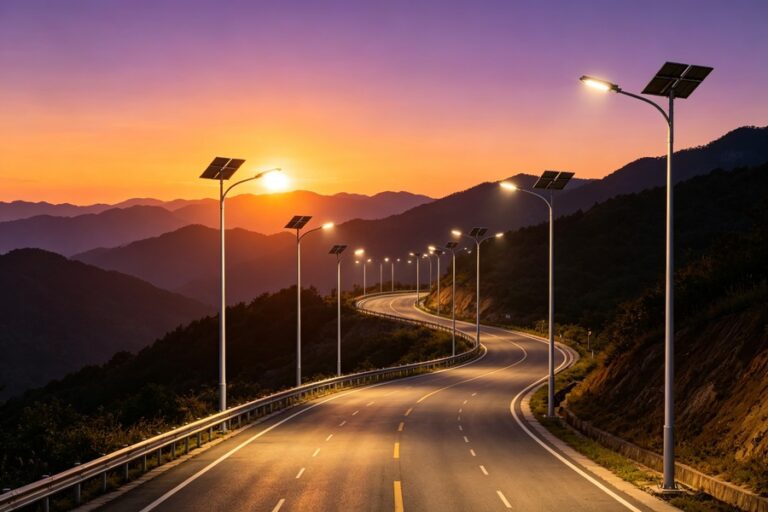
Solar street light for mining area road
Date: August 19, 2026
Solar street lighting for mining area access roads addresses a critical need for safety and operational continuity in a uniquely demanding environment. These roads, essential for the transport of personnel, equipment, and materials, are often remote, lack existing grid infrastructure, and are subject to extreme conditions including dust, vibration, and wide temperature swings. A solar lighting solution must be engineered not just for energy independence, but for exceptional durability, reliability, and sufficient illumination to mitigate the high risks associated with 24/7 mining operations.
Robust Design for Harsh Environmental Resilience
The defining requirement for mining road lights is extreme durability. Fixtures and poles must withstand constant exposure to corrosive elements, high levels of particulate dust and moisture, and potential impacts from flying debris or accidental contact with equipment. Housing should be constructed from high-grade, corrosion-resistant aluminum alloys with a heavy-duty powder-coat finish. The optical assembly requires a sealed, gasketed design with a high Ingress Protection rating to prevent dust and water ingress. Given the heavy vehicle traffic and potential for ground movement, poles must have a robust structural design, often with a hot-dip galvanized steel finish, and be installed with deep, reinforced foundations to resist high wind loads and vibration from nearby machinery.
High-Performance Lighting for Safety in Hazardous Terrain
Illumination standards for mining roads are stringent. The lighting must provide excellent uniformity and high vertical illuminance to ensure the safe movement of large, slow-moving vehicles like haul trucks, which have significant blind spots. A broad, asymmetric light distribution is key to evenly illuminating the road surface and its shoulders. Luminaries with a high Color Rendering Index improve driver and pedestrian ability to recognize hazards, terrain changes, and signage. Given the long distances often involved, a system of high-lumen-output fixtures mounted on taller poles (8-12 meters) is typical to achieve the necessary light spread and overlap, reducing dark spots between poles. Smart controls with motion sensors can be integrated to boost brightness when activity is detected, conserving energy during low-traffic periods.
Reliable Off-Grid Power and System Maintenance
Energy reliability is non-negotiable. The solar PV panels must have a high conversion efficiency and be kept clean; a significant tilt angle can help mitigate dust accumulation. Battery systems face the dual challenge of providing ample storage for long winter nights and operating reliably in temperature extremes. Lithium iron phosphate batteries are increasingly favored for their longer lifespan, superior thermal stability, and depth of discharge compared to traditional lead-acid. The charge controller must include advanced battery management features like temperature compensation. For maximum uptime, a modular design where key components (battery, controller, LED driver) can be easily accessed and replaced in the field is highly advantageous. Implementing a remote monitoring system, if feasible, allows for proactive maintenance by alerting operators to performance drops or faults, preventing extended periods of darkness on critical haul routes.
Recommended articles

Solar street light with high transmittance lens
October 13, 2026
Solar street light with insulated wiring
October 13, 2026