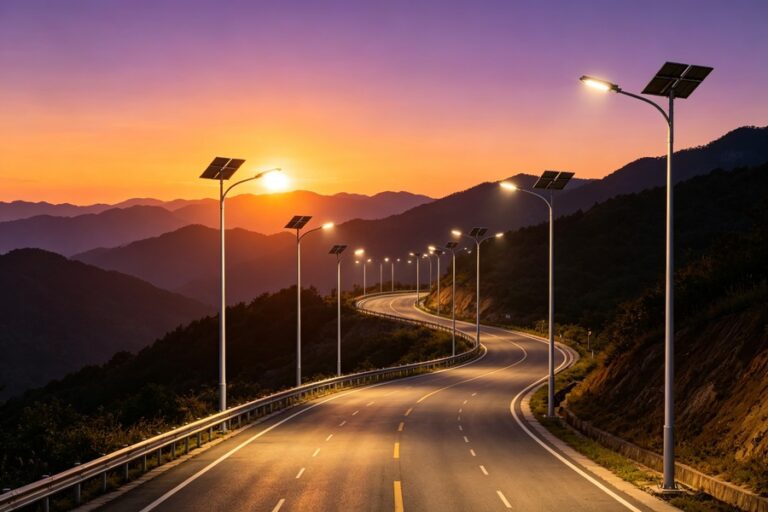
Solar street light for border road
Date: August 19, 2026
Solar street lighting for border roads serves a vital dual purpose: ensuring safe patrol and transit while establishing a clear, visible security perimeter. These installations operate in remote, often rugged terrain with no grid access, demanding a system that is completely self-sufficient, highly reliable, and resilient against both environmental and human threats. The design priorities extend beyond basic illumination to encompass security enhancement, extreme durability, and uninterrupted operation in all weather conditions.
Security-Focused Illumination and Surveillance Support
The lighting scheme must eliminate shadows and dark zones that could compromise surveillance. This requires a layout with careful pole placement to achieve consistent, overlapping coverage along the entire road and its immediate periphery. Lighting levels should meet or exceed standards for high-security areas, providing sufficient vertical illuminance to support CCTV camera effectiveness and allow for clear identification at a distance. The use of smart lighting systems with integrated motion sensors is particularly valuable; they can operate in a dimmed state for energy conservation and instantly trigger full brightness upon detecting movement, alerting patrols to activity. The color temperature of the light is also a consideration, with cooler white light often preferred for its higher scotopic visual effectiveness, improving night-time acuity for security personnel.
Engineered for Extreme Environments and Vandal Resistance
Border areas can present the harshest environmental challenges—extreme temperature swings, high winds, sandstorms, heavy snow, or salt spray. Fixtures require an exceptionally high Ingress Protection rating and corrosion-resistant construction, typically using marine-grade aluminum and stainless-steel hardware. Mounting poles must be structurally engineered for the specific wind and ice loads of the location, with foundations that account for potential soil instability. Given the critical security function, the system must be highly resistant to tampering, vandalism, and theft. This involves using tamper-proof fasteners, housing batteries and controllers in locked, reinforced compartments at the top of the pole or in below-ground vaults, and even employing anti-climbing features on poles.
Autonomous Energy Security and Communication Capabilities
Energy reliability is paramount. Solar panel arrays must be oversized to account for reduced winter sun and potential snow cover, with steep tilt angles to aid snow shedding. Battery storage capacity needs to support extended autonomy through consecutive cloudy days and long winter nights, with lithium iron phosphate technology being the leading choice for its lifespan and performance in temperature extremes. For critical sections, a hybrid system incorporating a small backup wind turbine can provide additional energy security. Furthermore, modern systems can integrate low-power wireless communication modules, enabling remote performance monitoring, fault alerts, and control of lighting schedules from a central command post, reducing the need for physical patrols solely for maintenance checks and enhancing overall operational efficiency.
Recommended articles

Solar street light with high transmittance lens
October 13, 2026
Solar street light with insulated wiring
October 13, 2026