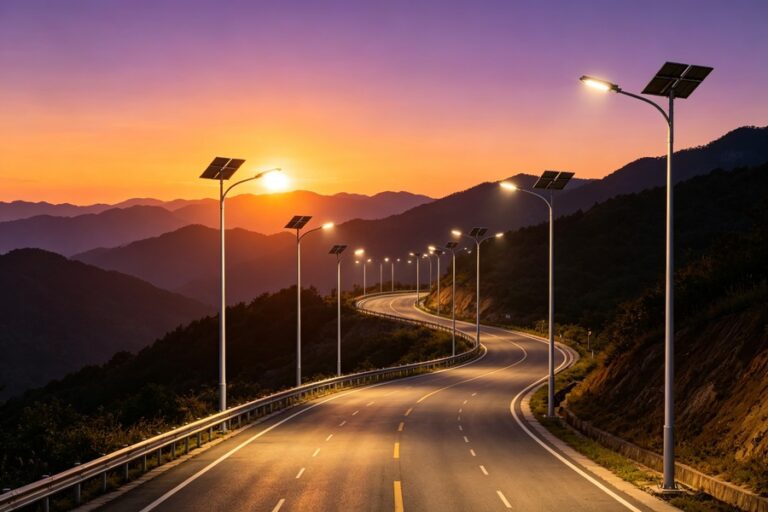
Solar street light for coastal area
Date: August 17, 2026
Coastal environments present a unique set of challenges for outdoor lighting. High humidity, salt spray, and strong winds can quickly degrade standard fixtures. A well-chosen solar street light offers a resilient, off-grid solution, but its components must be specifically engineered to withstand these corrosive conditions year after year. The right design focuses on protection at every level, from the external shell to the internal battery chemistry.
Material and Coating Specifications for Salt Resistance
The primary defense against coastal corrosion is the external housing. Fixtures constructed from marine-grade aluminum alloys, such as 5052 or 6063, provide an excellent balance of strength and natural corrosion resistance. The critical step is the application of a specialized surface treatment. A multi-layer coating process is essential. This typically begins with a pretreatment for adhesion, followed by a thick powder coating finish. The powder coat should be specifically formulated for high UV resistance and salt fog protection, often meeting or exceeding industry standards like ASTM B117 for salt spray testing. For maximum durability in the harshest zones, lights featuring a stainless steel (grade 304 or 316) housing or critical structural brackets offer superior longevity, though at a higher initial investment. Every seal, gasket, and lens must also be made from UV-stabilized and salt-resistant polymers to prevent brittleness and clouding.
Structural Integrity Against Wind and Weather
Coastal areas are frequently subject to high winds and occasional storm surges. The pole and mounting system must be designed for these dynamic loads. A hot-dip galvanized steel pole provides a robust and corrosion-resistant foundation. The foundation’s depth and concrete mass should be calculated based on local wind speed data and soil conditions to prevent tilting or failure. The arm connecting the light to the pole should be aerodynamically shaped to reduce wind resistance. Importantly, all cable entry points and service panels must be located high enough on the pole to avoid immersion from stormwater runoff or splash, and should be sealed with waterproof, corrosion-resistant conduit glands.
Optimal Solar Panel and Battery Configuration
Consistent performance in coastal areas requires overcoming salt haze and frequent overcast conditions. Using high-efficiency monocrystalline solar panels with a robust, anodized aluminum frame is recommended. Their higher energy conversion rate captures more sunlight during shorter winter days or hazy conditions. The tilt angle of the panel should be optimized for the specific latitude to maximize annual energy harvest. For energy storage, lithium iron phosphate (LiFePO4) batteries are increasingly the standard for coastal solar lights. Compared to traditional lead-acid batteries, they offer a longer lifespan, better performance across a wider temperature range, higher depth of discharge, and superior resistance to the corrosive internal environment that can be exacerbated by coastal humidity. The battery compartment must be fully sealed, waterproof, and ideally include a breathable vent to manage any potential moisture buildup.
Photocell and Smart Control Considerations
Reliable operation depends on consistent dusk-to-dawn activation. A high-quality, epoxy-potted photocell is necessary to protect its sensitive circuitry from salt and humidity. For enhanced reliability and energy management, models with integrated smart controllers offer significant advantages. These systems can adjust lighting output based on the battery’s charge level, dimming the lights during periods of low solar input to extend operation through multiple cloudy nights. Motion-sensing capabilities can also be integrated, providing full brightness only when activity is detected, which further conserves energy and extends the system’s operational life during prolonged inclement weather.
Recommended articles

Solar street light with high transmittance lens
October 13, 2026
Solar street light with insulated wiring
October 13, 2026