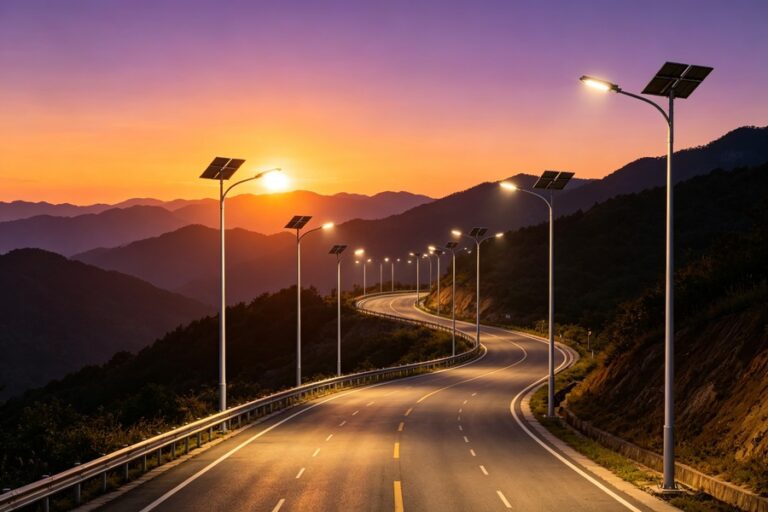
Solar street light for farm access road
Date: August 18, 2026
Deploying Solar Street Lighting for Secure and Cost-Effective Farm Access Roads
Illuminating farm access roads with solar-powered lighting addresses a distinct set of operational and safety challenges unique to agricultural settings. Unlike campus pathways with consistent nightly foot traffic, farm roads serve critical but often intermittent functions—guiding late-night equipment movement, enabling safe shift changes for workers, securing perimeter areas, and facilitating emergency access—all while traversing expansive, grid-remote locations. Implementing a solar solution here provides dependable, off-grid illumination that enhances security, supports 24/7 operations, and eliminates the prohibitive cost of trenching and connecting to distant utility lines.
Assessing Agricultural Road Specifications and Environmental Demands
The design process begins with a practical assessment of the roadway’s primary use cases. Heavy equipment and vehicle traffic necessitates lighting that provides ample vertical and horizontal illumination to ensure safe maneuvering of wide machinery, with careful attention to minimizing glare for operators. Poles must be setback adequately to avoid collisions. For perimeter and security-focused lighting, the emphasis shifts to broader area coverage and reliable dusk-to-dawn operation with potential motion-sensing capabilities to activate higher brightness levels upon detecting movement. A critical environmental factor is the high potential for dust, chemical spray drift, and moisture. Components require superior ingress protection (IP66/67 or higher) and corrosion-resistant finishes. The solar array mounting must also consider seasonal sun angle changes and ensure winter sunlight is not obstructed by structures or tree lines.
Selecting Robust Components for Harsh Rural Conditions
Durability and autonomy are paramount. The solar panel must have a high conversion efficiency to maximize energy harvest during shorter winter days and should feature a robust, frameless design to resist dust accumulation and withstand high winds. The battery bank requires a capacity sized for “days of autonomy” to power lights through consecutive cloudy or rainy periods common in many agricultural regions; maintenance-free, deep-cycle lithium or advanced lead-carbon batteries housed in weatherproof enclosures are typical choices. LED luminaires should offer a high Color Rendering Index (CRI) to improve object recognition under artificial light and a correlated color temperature (CCT) that minimizes insect attraction. Fixtures and poles should be constructed from hot-dip galvanized steel to resist corrosion from fertilizers and moisture. Integrating smart controls with adaptive lighting profiles (e.g., dimming to 30% after midnight, then brightening upon motion detection) drastically extends system runtime and battery life.
Installation Strategies for Flexibility and Long-Term Reliability
Installation on farm roads favors flexibility and minimal ground disturbance. Ground-mounted solar arrays connected to remotely placed lights via underground cable are often used where optimal solar exposure is not available directly at the lighting point. For simpler deployments, all-in-one or split-type systems with panels mounted directly on the light pole are common. Foundations must be designed to withstand vibration from nearby heavy machinery and potential flooding. Given the large areas involved, creating a wireless mesh network for lighting control allows for centralized management of dozens of lights from a farm office, enabling easy scheduling adjustments for harvest seasons and remote fault monitoring without the need for extensive wiring.
Maintenance Planning and Integration with Farm Operations
A straightforward, farmer-manageable maintenance plan is essential for long-term success. This includes an annual inspection schedule to clean solar panels, check electrical connections for corrosion, and verify structural integrity. Choosing systems with modular components allows for easy field replacement of parts like batteries or drivers. Furthermore, the lighting system’s power surplus during high-sunlight periods can be explored for secondary low-voltage applications, such as powering wireless soil sensor gateways, security cameras at remote gates, or LED signage. This transforms the lighting infrastructure into a multipurpose off-grid power node, adding tangible value beyond illumination and solidifying its role as a practical, modern asset for the working farm.
Recommended articles

Solar street light with high transmittance lens
October 13, 2026
Solar street light with insulated wiring
October 13, 2026